


A Bavarian idyll


Hirschberg Castle, near Weilheim, in 1912 and today
Public domain via Wikimedia Commons / Gras-Ober Wikimedia Commons cc-by-sa-3.0
About an hour’s drive from Munich, Hirschberg am Haarsee Castle can still be admired today. This picture-perfect castle has stood resplendent in idyllic countryside since 1909. “This magnificent castle is a jewel of the region”, enthused the Weilheimer Tageblatt newspaper shortly after its construction. Throughout its turbulent history, it provided a welcome retreat and a home for many an aristocrat, far away from the hustle and bustle of the city. One such resident was the art collector and patron James von Bleichröder.
The Bleichröder Bank

Emile Wauters († 1933), Public domain, via Wikimedia Commons
James von Bleichröder is born in 1859 in Berlin. He is the third child of the banker Gerson Bleichröder. His father was part of Germany’s financial elite.

Federal Archives, Image 183-2007-0307-501 / CC-BY-SA 3.0

Image archive photo Marburg, photo no.: fmkbb7910
The family enjoys a high social standing as Gerson Bleichröder is not only an extremely successful businessman but also served as the banker to Otto von Bismarck and Kaiser Wilhelm I. In 1872 Gerson Bleichröder has a title bestowed upon him in recognition of his services and is now allowed to call himself Gerson von Bleichröder. He is the first Jew in Prussia to receive such an honor.
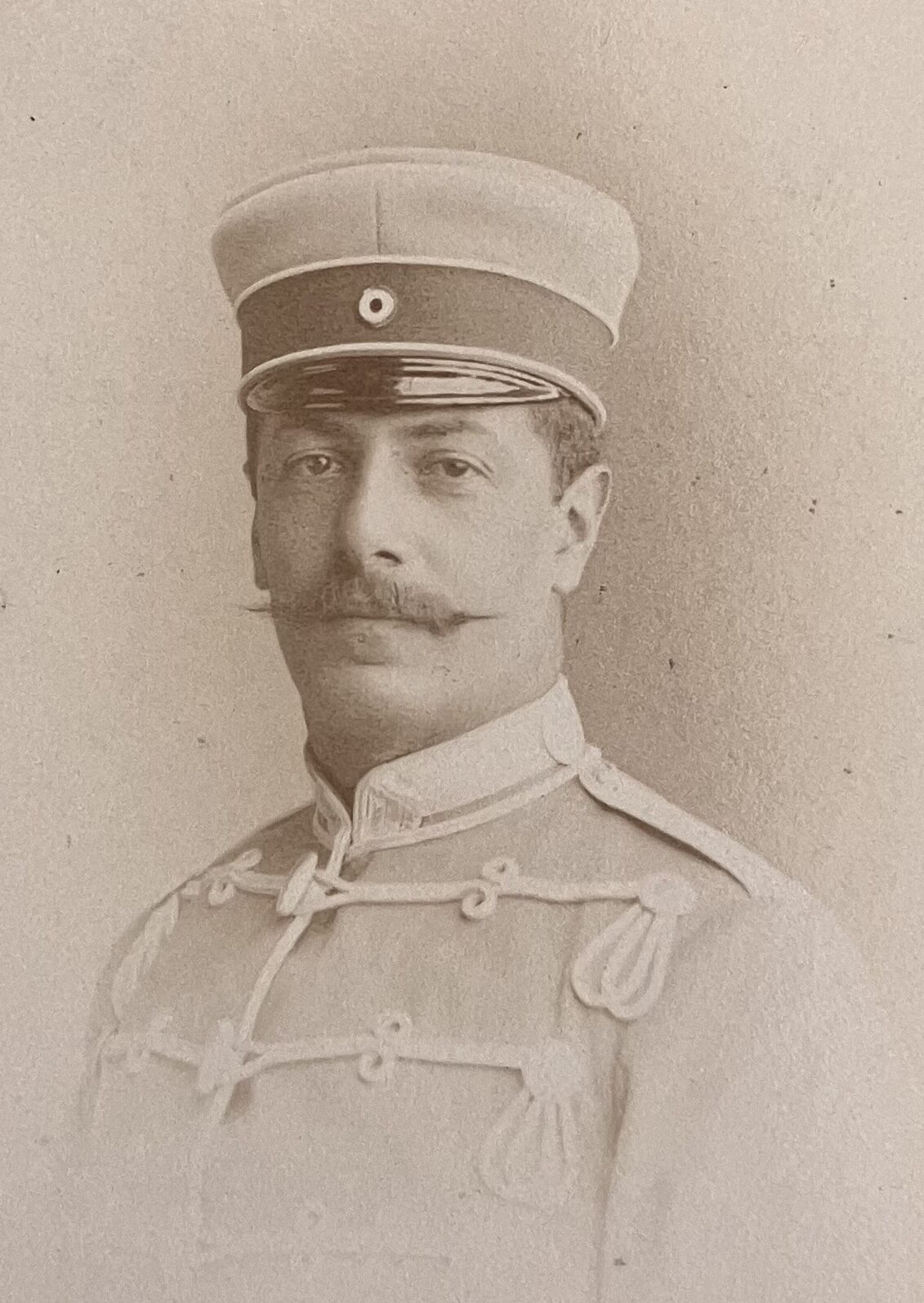
Berlin State Archives, E Rep 200-33 No. 20
James von Bleichröder grows up at his parents’ residence in Berlin-Charlottenburg. The von Bleichröders are considered ‘assimilated Jews’, in other words, they adapted as much as possible to the culture of Prussia, the dominant state within the German empire . This means, for example, that James joins one of Berlin’s student corps, an elite student fraternity. From 1880 to 1886 he studies law, ultimately gaining a doctorate. His father introduces him to Prussian high society and to leading artists. With the inheritance they receive after their father’s death, Gerson von Bleichröder’s three sons Georg, Hans, and James are able to live a life of luxury. A second cousin continues to manage the day-to-day business at the bank.
In 1888 James marries Harriet Alexander. They go on to have five children: Curt, Edgar, Ellie, Harriet, and Victor. However, the couple has a rocky marriage and they divorce in 1902.
Art, culture, and fast cars

Berlin State Archives, E Rep 200-33 No. 20
With no financial concerns, James is able to pursue multiple leisure activities. His greatest passion is for cars. He even takes part in car races. In 1902 he donates Palais Bleichröder to the Kaiserliche Automobilclub (KAC, Imperial Automobile Club) for use as a club house.


From the guide to Berlin Zoological Garden, 1914
Like Gerson von Bleichröder he regularly donates to fund medical research and hospitals. He continues his father’s legacy by supporting Berlin Zoological Garden. In 1910 he purchases a hippopotamus for the zoo.

From the Lepke auction catalog

Christian Mitko / NEUMEISTER Münchener Kunstauktionshaus GmbH & Co. KG
He also follows in his father’s footsteps by collecting art. His collection contained paintings and sketches by famous artists including Adolph von Menzel, along with tapestries, fine furniture, and Meissen porcelain. It also includes ethnological pieces such as Egyptian sculpture. His son Edgar inherits his passion for art and becomes a painter by profession.
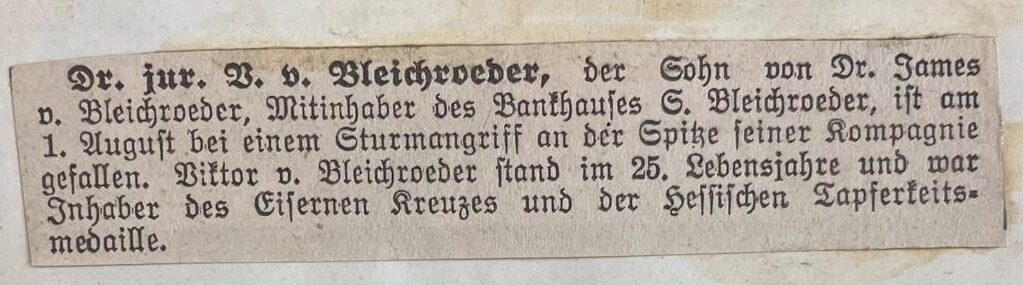
Berlin State Archives, A Pr.Br. Rep. 030, No. 9128
The Bleichröders’ support for conservative-nationalist politics is another product of their assimilation. James joins the Prussian military. When World War One breaks out, he volunteers for active service. His sons Curt, Edgar, and Victor also serve in the war. Victor dies on the front in 1915.

Leo Baeck Institute, Gerson von Bleichroeder Family Collection.
In 1918 James becomes a father again. He and his third wife Maria have a son, Wolfgang. In 1923 the family moves to Hirschberg Castle, near Munich. James relocates the majority of his art collection there.

Bayerische Staatsgemäldesammlungen 🔍 Hover over image to enlarge
he acquires the painting Auferweckung des Lazarus (The Raising of Lazarus).


A love of travel
James and Maria von Bleichröder are keen travelers. This can be seen from the many postcards and photographs that they send to their son. This is also true of the card from Nice, which shows the couple strolling along the beach promenade with a friend.
‘Half Jews’ and ‘full Jews’: National Socialist racial mania

Leo Baeck Institute, Gerson von Bleichroeder Family Collection.
When the National Socialists came to power in 1933, the Bleichröders were among those whose lives changed forever. Although James is a Christian, having been baptized as a young man, the National Socialists classed him and his children from his first marriage as Jews, while Wolfgang is considered a ‘half Jew’ (someone with one Jewish parent or two Jewish grandparents). Edgar is therefore excluded from the Reichskammer der bildenden Künste (Reich Chamber of Fine Arts) and unable to continue his profession as an artist. As a result of the Nuremberg Race Laws of 1935 , the Bleichröder banking house is ‘Aryanized’ (expropriated and transferred to non-Jewish ownership) in 1937, and subsequently liquidated.

James dies in 1937 at the age of 77. After his death his art collection is auctioned off by the Berlin auction house Lepke. The Munich art dealer Julius Böhler purchases the Auferweckung des Lazarus at this auction.
A very prominent client buys the painting from Böhler for his own private collection: General Field Marshal Hermann Göring. He pays the princely sum of 8,000 Reichsmarks for it.

Federal Archives Picture 183-C10110
Hermann Göring was, alongside Adolf Hitler, undoubtedly the main art collector among the National Socialist leadership elite. He used the artworks to present himself as a highly refined individual. Conversely, he also used his position as Minister President and General Field Marshal to indicate which works were to be considered particularly valuable and ‘German’. He often purchased works that had entered the market as a result of appropriation, persecution, or the murder of their rightful owners.

At the beginning of the 1940s the family's persecution worsens. Curt and Edgar, James’s sons from his first marriage, manage to emigrate to Switzerland in 1942. In the same year, their sisters Ellie and Harriet are captured. Ellie is interned in the Theresienstadt ghetto and concentration camp. She can be seen listening to a scholarly lecture in a short sequence from the propaganda film “Theresienstadt”. She is liberated from Theresienstadt by the Red Army in May 1945. Harriet is deported to Riga and murdered there. As a “Mischling” (person of “mixed blood”, with both Jewish and non-Jewish ancestry), Wolfgang von Bleichröder is due to be deployed as a forced laborer, but he manages to evade this by deliberately contracting jaundice. He later emigrates to the USA.
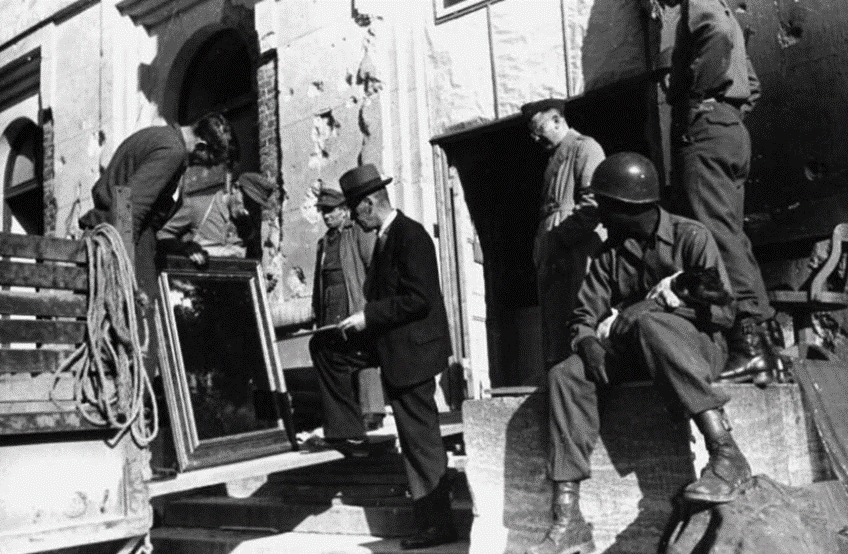
Photo archive at the Central Institute for Art History, Munich
Anxious about the advance of the Red Army, in 1945 Hermann Göring has parts of his art collection moved from his residence at Carinhall to Berchtesgaden. In spring 1945 American troops discover the artworks there and take them to the Central Collecting Point in Munich.
What happened to the painting?

Photo archive at the Central Institute for Art History, Munich
Among the artworks is the painting Auferweckung des Lazarus. In 1961 it enters the holdings of the Bayerische Staatsgemäldesammlungen (Bavarian State Painting Collections) as a “transfer from state ownership”.

The fact that the painting had been part of Göring’s collection led provenance researchers to suspect that it was looted art - especially since at this point it was not known if the widow Maria von Bleichröder had received the proceeds from the auction. Therefore the Bayerische Staatsgemäldesammlungen entered the painting in the "Lost Art" database. The rightful heirs subsequently got in touch.

Bayerische Staatsgemäldesammlungen
In 2017 the Bayerische Staatsgemäldesammlungen reaches an agreement with the heirs of James von Bleichröder in Munich and San Diego. The painting was to be restituted but it could be repurchased by the Bayerische Staatsgemäldesammlungen.

Bayerische Staatsgemäldesammlungen
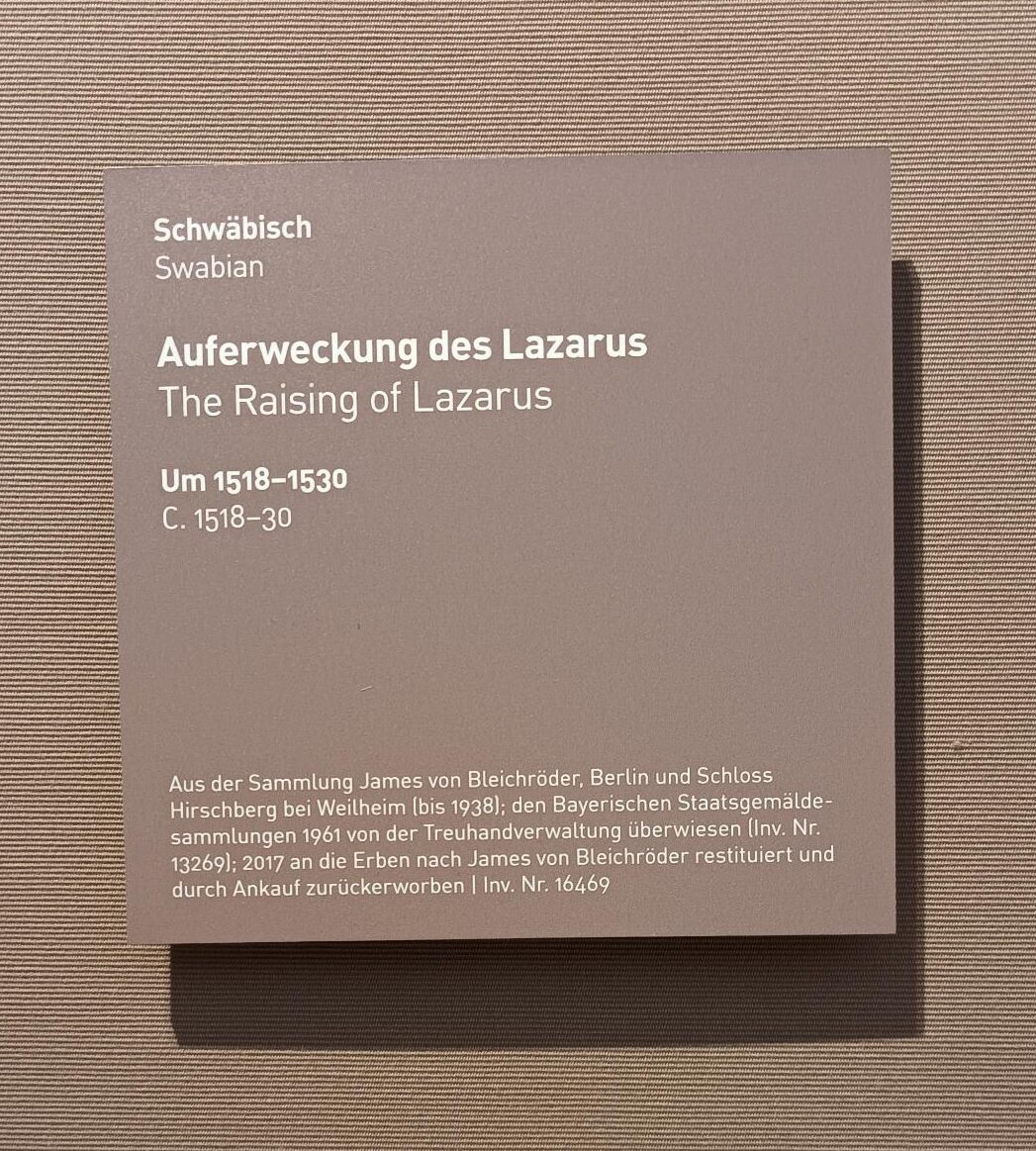
The Auferweckung des Lazarus can still be seen today at Johannisburg Castle in Aschaffenburg. There is now an information panel explaining the origins of the painting and the history of its restitution.





