


The joy of collecting together

Saint Louis Art Museum, Bequest of Morton D. May 845:1983
Son of a Jewish merchant family
Curt Glaser was born in Leipzig on 29 May 1879, the son of the Jewish merchant Simon Glaser. When he was seven years old, he moved to Berlin with his parents and his younger brother Paul. He went to school there, graduated from high school and began his career as an art historian. Berlin became the centre of his life.

Munchmuseet, Oslo. CC BY-NC-SA 4.0
Marriage to Elsa Kolker
In 1903, he married Elsa Kolker (1878-1932), the daughter of a textile manufacturer in Wroclaw. She brought a large fortune into the marriage, which allowed the couple to live luxuriously, travel extensively and collect art on a grand scale.

Munchmuseet, Oslo. CC BY-NC-SA 4.0 🔍 Hover over the image to enlarge
Across Europe
Curt and Elsa Glaser are particularly interested in contemporary art, which we now call „classical modernism“. They knew a lot of famous artists. For example, they travelled to Paris to visit Henri Matisse. And in 1913, they travelled by car to Oslo to see Edvard Munch.

Munchmuseet, Oslo.
Portrayed during the visit
Munch seizes the opportunity: he paints the „Portrait of a Lady“ of Elsa and the double portrait of Mr and Mrs Glaser.

Munchmuseet, Oslo. CC BY-NC-SA 4.0
Best pen pals
Edvard Munch and Curt Glaser became close friends. They wrote many letters and postcards to each other, which can now be found in the archives of the Munchmuseet Oslo. Incidentally, you can read them all view and read online.
Curt Glaser even wrote a book about his artist friend, many of whose artworks he has in his private collection. He illustrates it with original etchings by Edvard Munch.
The scientist

Wikimedia Commons, public domain
Twice as talented
Glaser is a scholar with two legs to stand on - and two doctorates: in 1902 he obtained his doctorate in medicine and in 1907 in art history.

National Museums in Berlin, Central Archive. CC BY-SA 4.0
Beginnings as an „unskilled labourer“
In 1909, he began working as a „scientific assistant“ at the Berlin Kupferstichkabinett. A short time later, he converted to Protestantism. It is possible that he hoped this would give him better opportunities in the Prussian civil service.

bpk / Kupferstichkabinett, SMB / Dietmar Katz
Career in the civil service
And it works: Glaser makes a career! He stayed at the Kupferstichkabinett until 1924 and became curator for contemporary graphic art. It is thanks to him that the museum now has one of the largest Munch collections in the world. He then became director of the State Art Library.
A house of art

In the „garden house“
In 1925, Elsa and Curt Glaser moved into an extension to the former teaching centre of the Museum of Decorative Arts, which housed the art library. Glaser did not have far to go to work.

bpk / Staatsbibliothek zu Berlin 🔍 Hover over the image to enlarge
Monday reception
The new flat becomes a meeting place for celebrities from the art scene.
Arthur Rosins on Curt Glaser and his wife Elsa, 1965.
„Curt Glaser's house in Berlin [...] was one of the centres of Berlin's intellectual life.“

Berlin State Archive, F Rep. 290-05-01 No. 71 / Photo: Marta Huth

Berlin State Archive, F Rep. 290-05-01 No. 70 / Photo: Marta Huth

Berlin State Archive, F Rep. 290-05-01 No. 69 / Photo: Marta Huth
Beckmann on the easel
The Glasers' home is full of art. In his private library, for example, there is a portrait on an easel that Max Beckmann painted of Curt Glaser in 1929.
Collapse
Curt Glaser to Edvard Munch, 19 May 1933 (Munchmuseet, Oslo)
Elsa died in July 1932 at the age of 54. Curt Glaser was deeply shocked by her death, as he confided to his friend Edvard Munch.

Munchmuseet, Oslo. CC BY-NC-SA 4.0
A new love in times of crisis
Just under a year later, in May 1933, Curt Glaser married the singer Maria Milch (1901-1981) for the second time. She came from a wealthy German-Jewish family, but was brought up as a Protestant.
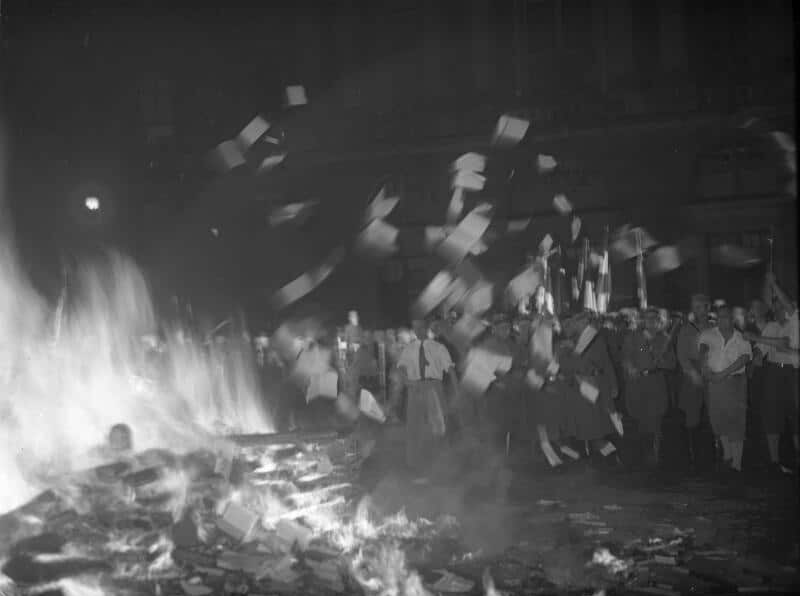
Federal Archives, Picture 102-14599 / Georg Pahl
„Against the un-German spirit“
Regardless of whether they were raised Protestant or baptised late: Curt and Maria Glaser were considered Jewish by the Nazi regime. What's more, Curt Glaser had championed modernism, which was hated by the Nazis. As a library director, he must have been shocked when, on 10 May 1933, books that the regime did not tolerate were burned on Berlin's Opernplatz under the slogan „against the un-German spirit“.
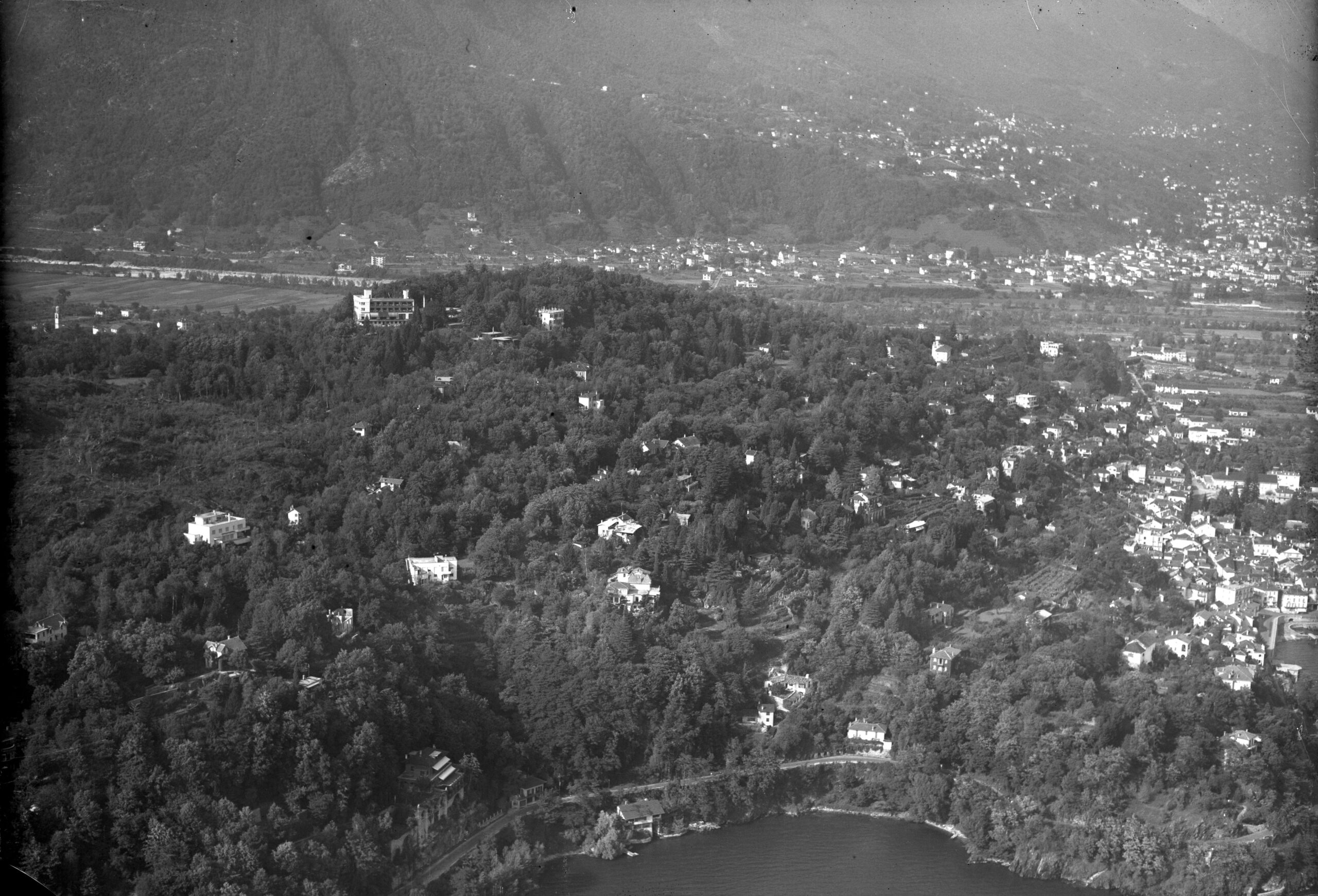
ETH Library / Werner Friedli. Wikimedia Commons, CC BY-SA 4.0
Loss of office
Around the same time, Glaser is forced to take a leave of absence as director of the art library and is forced to retire in September 1933. In the German newspaper „Deutsche Zeitung“, the headline ‚Mr Glaser goes on holiday‘ is used to agitate against him. He is a representative of the democratic Weimar Republic, which is slandered by the right-wing radicals as corrupt and 'Judaised'.

bpk

National Museums in Berlin, Central Archive. CC BY-SA 4.0
The Gestapo moves in
Glaser also had to give up his flat in Prinz-Albrecht-Straße and the art library had to move out. The building complex becomes the headquarters of the Gestapo, the Secret State Police.
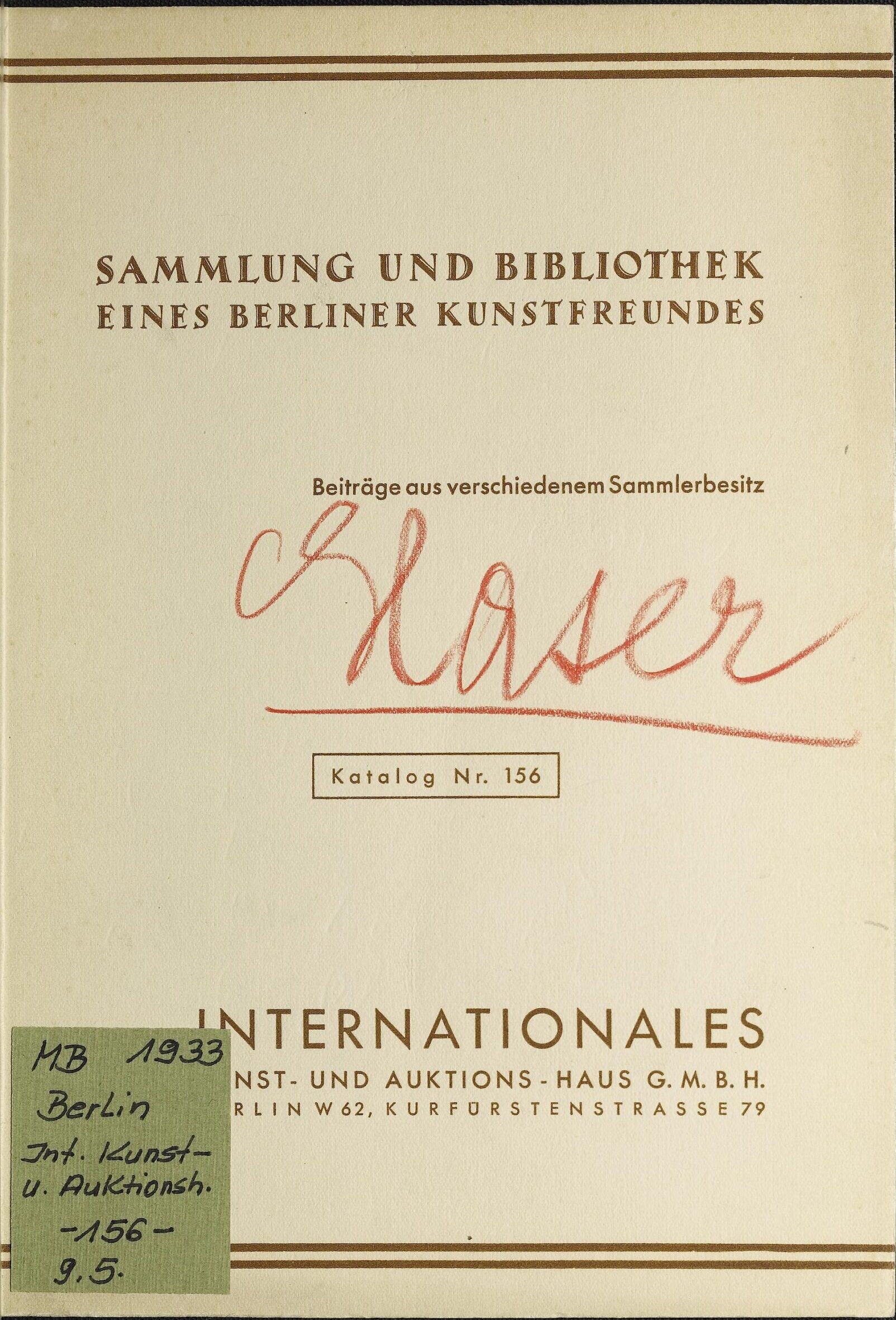
https://doi.org/10.11588/diglit.6195#0001
Everything about the auction
Glaser realises that he no longer has a future in Germany. He puts his home furnishings, library and art collection up for auction. He commissions the International Art and Auction House and the auctioneer Max Perl, both from Berlin, to organise the auction.
In exile
ETH Library / Werner Friedli. Wikimedia Commons, CC BY-SA 4.0
Exile in Ascona
Shortly after the auctions, Curt and Maria Glaser go into exile. They initially lived in Ascona in Ticino for several years. This is a famous drop-out and artists' colony, frequented by painters and sculptors such as Paul Klee, Alexej Jawlensky and Marianne Werefkin. The couple also lived in Florence for periods.

Family collection
A short life
On 22 July 1935, the couple had a daughter, Eva Glaser. The child would never grow up. She died on 10 February 1943 in a home for handicapped children near Basel.

Final years in the USA
After Curt Glaser was unable to regain a foothold professionally in Switzerland, the couple emigrated to the USA via Havana. On 13 May 1941, they landed in New York on the ship „Monterey“.
Not even a year after his young daughter, Curt Glaser died of tuberculosis on 23 November 1943 in Lake Placid in the state of New York.

Brandenburg State Main Archive Potsdam, Rep. 36 A II, No. 11320, sheet 4 🔍 Move the mouse over the image to enlarge it
Residual assets confiscated
The assets that Curt Glaser left behind when he emigrated to Germany were confiscated by the Gestapo in favour of the German Reich after his death.
Restitution

bpk / Kupferstichkabinett, SMB / Volker-H. Schneider 🔍 Move the mouse over the image to zoom in
In 2012, the Staatliche Museen zu Berlin restituted four works of art on paper by Edvard Munch and Ernst Ludwig Kirchner to the heirs of Curt Glaser. They came from the 1933 Max Perl auction.

Staatliche Museen zu Berlin, Kupferstichkabinett / Dietmar Katz. Public Domain Mark 1.0 🔍 Move mouse over the image to zoom in
Five further works can remain with the Staatliche Museen zu Berlin with the consent of the community of heirs in memory of the former director of the Kunstbibliothek.
The Bavarian State Painting Collections also restituted works to the heirs of Curt Glaser in 2013: two watercolour pencil drawings by the Expressionist painter Max Pechstein.





