


Photo: Frank Marten Pfeiffer, 2025

Photo: Frank Marten Pfeiffer, 2025
Frankfurt am Main, not far from the main train station. A small side street in a new development area bears the name Harry Fuld. However inconspicuous the place may seem at first glance: behind the street name lies an entrepreneur who was groundbreaking for the spread of telephones in Germany – „one of the pioneers in the telecommunications market“.
A Frankfurt success story

From: Leo Parth: Harry Fuld. A Sketch of His Life (Private printing by the firm H. Fuld & Co., Frankfurt am Main), 1932
Harry Herz Salomon Fuld was born in Frankfurt am Main in 1879. His mother, née Goldschmidt, comes from a family of successful art and antique dealers. His father is co-owner of the Goldschmidt art dealership. He dies when Harry is three years old.
Harry Fuld apprentices as a tradesman. Although he is very interested in art, to his great disappointment he cannot get into the art dealership; his maternal family does not see a place for him there.

Company archive, via www.gvit.de
At the age of 19, Harry Fuld founds his own company, „Deutsche Privat-Telefongesellschaft H. Fuld & Co“. He leases ready-to-use telephone systems, a business model previously unknown in Germany.
Buying a phone for private or business use had previously been associated with high costs: installation was complex and repairs were frequent. Fuld has great success with renting in an affordable subscription model.

Museum Foundation for Post and Telecommunications, 4.2008.1199. CC BY SA 4.0

Institute for Urban History Frankfurt am Main, S7A, No. 1998-29559
Before long, Fuld begins producing his own telephones. The company grows rapidly, building a large network of branches within a few years, and by around 1930 it is one of Europe's leading industrial companies.

Photo: Ralph Etter, 2025

Landesarchiv Berlin, B Rep. 025-07 No. 4884/59 Photo 4b / Photo: Waldemar Titzenthaler 🔍 Hover over the image with the mouse to enlarge
Harry Fuld marries three times. Each of his first two marriages produced a son: Harry Fuld junior (born 1913) and Peter Harry Fuld (born 1921).
In 1929, Fuld moves with his third wife, Lucie, from Frankfurt to Berlin, where the couple lives in a sumptuously appointed villa in Berlin-Grunewald.
Art remains a passion

Staatliche Museen zu Berlin, Gemäldegalerie / Jörg P. Anders 🔍 Hover over the image to zoom
Although Fuld does not pursue art as a profession, he remains intensely committed to it and builds a valuable art collection. Georg Swarzenski, the director of the Städel Museum in Frankfurt am Main, advises him in this endeavour.
Furthermore, Fuld is closely connected to the Frankfurt museum scene as a patron and lender of artworks.
„Orient – Middle Ages – Exotica – Modern!“
Georg Swarzenski on Harry Fuld's Art Collection, 1918

Jewish Museum Frankfurt
The Harry Fuld art collection is extremely diverse. It encompasses medieval sculptures and paintings, Asian art and arts and crafts, as well as contemporary art, including works by Emil Nolde, Paul Klee, and Henri Matisse.

From: Leo Parth: Harry Fuld. A Sketch of His Life (Private printing by the firm H. Fuld & Co., Frankfurt am Main), 1932
Harry Fuld also surrounds himself with many works of Christian art. For example, a near life-size crucifix hangs in his office. In his time, he is not the only collector with a Jewish background to own art with Christian motifs.
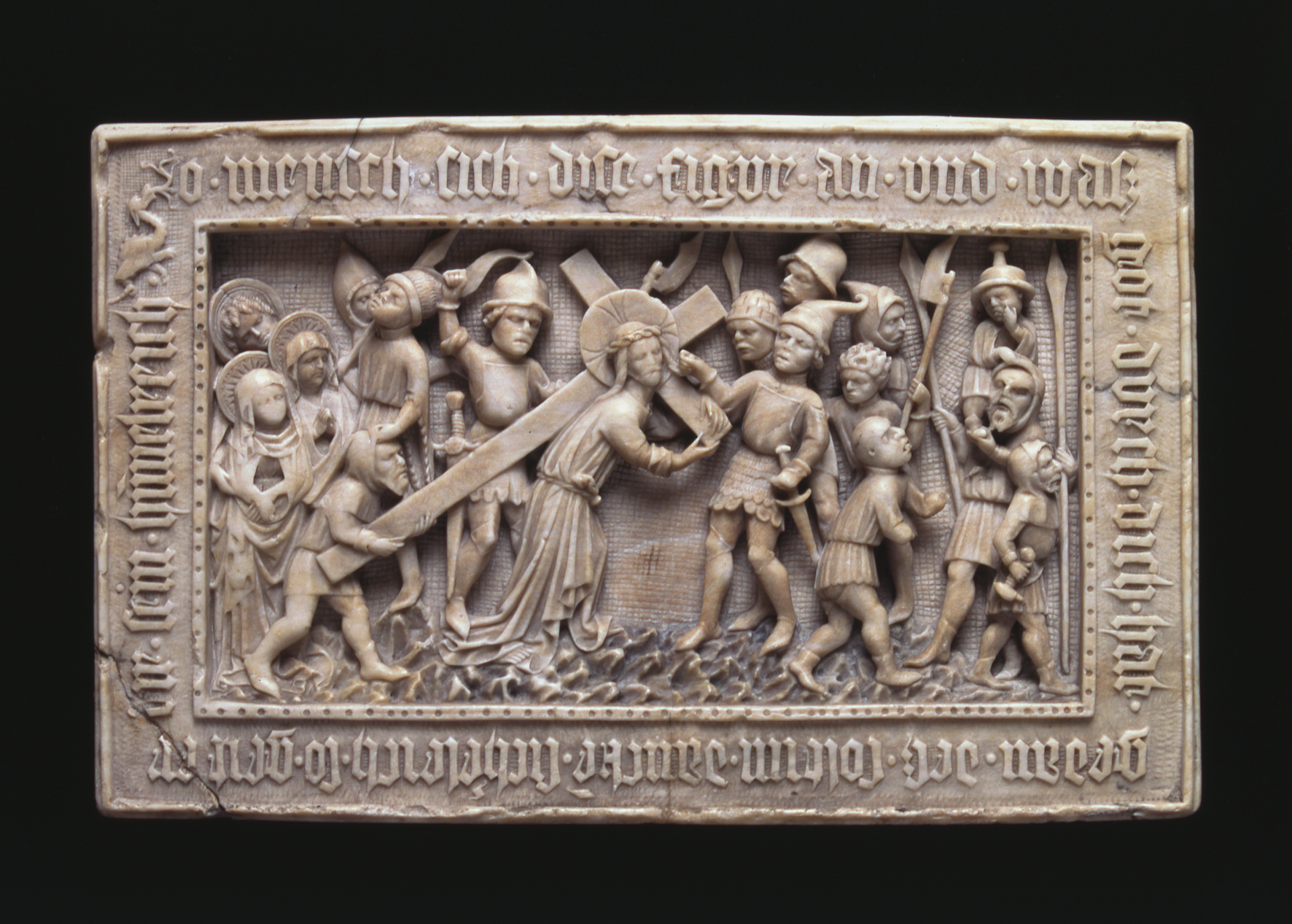
Staatliche Museen zu Berlin, Sculpture Collection and Museum of Byzantine Art / Antje Voigt 🔍 Hover over the image to zoom
But not only that: The relief shown here, depicting Christ carrying the cross, features demeaning, stereotypical depictions of Jews among the surrounding figures, who accompany the scene with grimaces or with their trousers down. Such antisemitic motifs were not uncommon in the often anti-Jewish society and Christian art of the late Middle Ages.

Institute for Urban History Frankfurt a. M., S7P, No. 4760

Bildarchiv Foto Marburg. CC BY-SA 4.0
After a restless working life, Harry Fuld dies of a heart attack on a business trip to Zurich in 1932. He leaves behind his third wife Lucie, as well as his two sons from his first and second marriages. Harry Fuld junior is 18 at the time, and Peter Fuld is 10 years old.
Flight and expropriation
The immense success of the Fuld Group had already roused envious competitors and zealous Nazis years before the National Socialist regime. As soon as Hitler comes to power at the end of January 1933, a boycott is imposed on the company starting in February. Under this pressure, the Jewish co-owners give up their shares in the company, many leave Germany and are later denaturalised by the NS state.
Fulda's widow, Lucie Mayer-Fuld, remarries in 1934. Persecuted as a Jew, she and her husband Acatiu Mayer-Fuld flee in 1939 via France and South America to New York.
Harry Fuld Jr. returns from a stay abroad in 1933, but cannot work in his father's company as planned. The exclusion of Jews from German economic life is advancing relentlessly.
Fuld Junior is forced to leave the country. He goes to Vienna first, and in 1937, he moves to England.

University of Toronto Archives. Torontonensis, vol. 47 (1945), p. 43.
Peter Fuld, the younger of the two half-brothers, is initially still under the protection of his mother, who is not Jewish. She sends him to a school in Switzerland in 1937. Afterwards, Peter begins his studies in England.

The National Archives (UK), ref. HO396/152 🔍 Hover over the image to zoom
AAt the start of the Second World War in 1939, both brothers are in England, but they are no longer safe here either: as German citizens, they are considered ‚enemy aliens', foreigners from hostile states. They are arrested and sent to internment camps: Harry Fuld junior to Australia, Peter Fuld to Canada.
Later, they return to Europe. Harry Fuld Jr. lives in London from 1943 until his death in 1963. After his release, Peter Fuld studies law in Canada but returns to Europe after the war. He dies in 1962 in his hometown of Frankfurt am Main. Neither of them have children.

Archive Friedrich Wolters, Coesfeld 🔍 Hover over the image to zoom in
The art collection put together by Harry Fuld Senior is to be divided among his three heirs. Many works remain in Germany when Lucie, Harry Junior, and Peter leave the country. This allows the Nazi authorities to gain access to them.
The art collection from the Grunewald villa, which Harry Fuld Senior and Lucie last resided in, is auctioned off at the Walther Achenbach auction house in Berlin on July 10th, 1940.
Harry Fuld Jr. stores valuable furnishings and artworks from his inheritance at a shipping company in Berlin. There, they are seized and auctioned off from January 27th-29th, 1943, at the Hans W. Lange auction house in Berlin.
Further artworks from the Fuld collection are still located at the company headquarters in Frankfurt am Main, where an estate administration of the family looks after them. The tax office is confiscating a masterpiece of Chinese art there: the more than 1,000-year-old bust of a man (Lohan) made of ceramic.

From Leo Parth: Harry Fuld. A life sketch, n.d. (1932)

Central Archive, National Museums in Berlin, I/MV, OAK 7, Bl. 207v 🔍 Hover over the image to zoom
In September 1943, the Reich Minister for Science, Education and Public Instruction request the State Museums of Berlin's opinion on the Lohan bust. The Director General immediately goes to work trying to acquire the outstanding work of art for his collections. He is fully aware of its provenance: „It may be true that the former Jewish owner once intended to donate the bust to the city of Frankfurt. However, his wishes should no longer carry weight today.“ He added that the Berlin museums „have hitherto been completely bypassed in the disposal of Jewish art property.“
Correspondence follows, in which both Berlin and Frankfurt fiercely claim the piece for themselves. Eventually, the Reich Minister decides in favour of Berlin. The National Museums in Berlin acquire the bust in January 1944.
However, the work also does not find peace after the rule of the National Socialists: after the end of the war, it was taken to St. Petersburg by Soviet troops, where it is still located today.
Restitutions

State Museums of Berlin, Museum of Decorative Arts / Barbara Schröter
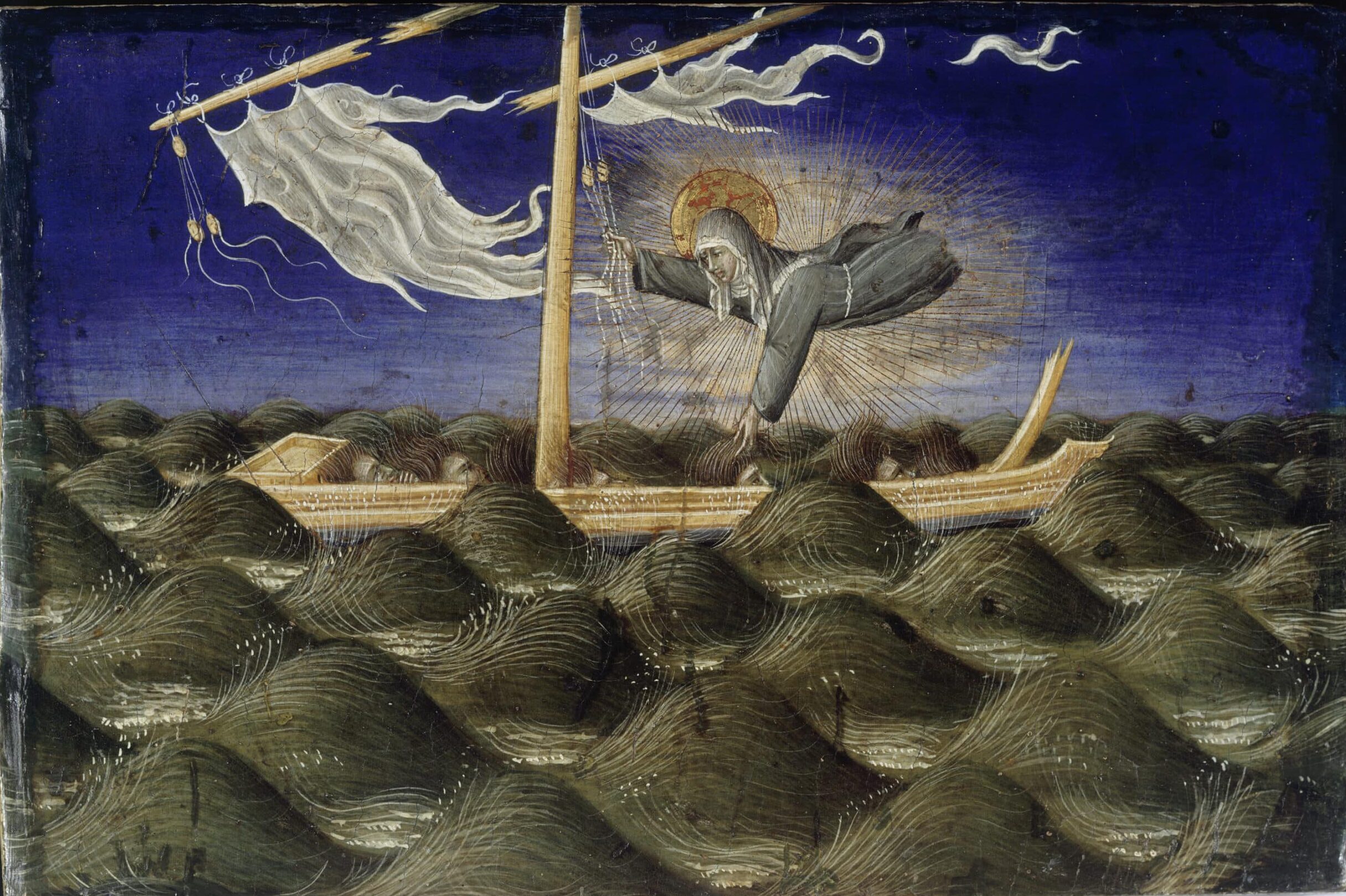
Staatliche Museen zu Berlin, Gemäldegalerie / Jörg P. Anders 🔍 Hover over the image to zoom
The heirs of Harry Fold applied for restitution and compensation for their losses after the war. However, some of the artworks confiscated due to persecution are only identified decades later in various museum collections.
The National Museums in Berlin – Prussian Cultural Heritage Foundation also return several works from the Fuld Collection from 2009 onwards, or reach just and fair solutions with the heirs.

Photo: Ralph Etter
The heirs of Harry Fuld junior
Before Harry Fuld Junior dies childless in 1963, he names Gisela Martin as his heir. We do not know what connected the two: were they friends or a couple? Did she run his household? In any case, Gisela Martin later bequeaths her possessions to a support organisation in Great Britain, which belongs to the Magen David Adom (Red Star of David) ambulance service in Israel. The organisation is part of the international Red Cross and Red Crescent movement.

MDA UK
The estate saves lives
Martin's inheritance initially comprises no valuable possessions. However, it then emerges that hidden within are artworks from the significant Fuld collection, which was confiscated and dispersed during the Nazi era. With the first restitutions, Gisela Martin's inheritance, and therefore Harry Fuld Junior's, suddenly becomes a very big deal.
Through Magen David Adom, Harry Fuld’s estate is now being used for charitable purposes. For example, along with other donations, it is being used to fund the construction of an important building in Israel: the blood donations stored there make the difference between life and death—regardless of the religious background of those in need.
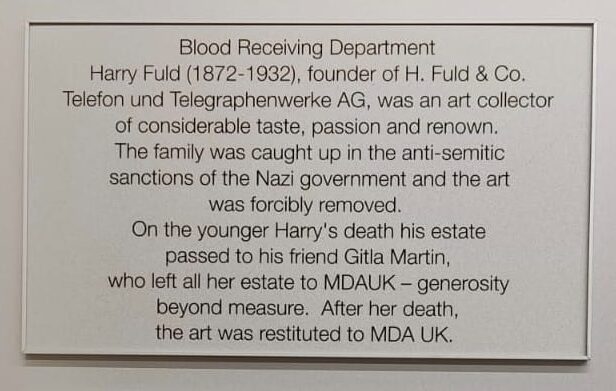
MDA UK
Today, a plaque in the building commemorates Harry Fuld Sr. and the fate of his art collection.

Peter Fuld Foundation
Peter Fuld
The estate of Peter Fuld, the younger son of Harry Fuld senior, also serves humanitarian purposes. The Peter Fuld Foundation was established in Frankfurt am Main in 1969. It supports disadvantaged and talented young people on their path to university and vocational training.
In doing so, the foundation is following the wishes of Peter Fuld, who had himself experienced exclusion and witnessed the discrimination of Black fellow students during his studies in Toronto.
The Peter Fuld Stiftung still bears the name of its founder today and at the same time preserves the memory of the family through its commitment to equal opportunities and social cohesion.
Thus, the memory of the Fulds is linked with a cosmopolitanism that remains encouraging to this day, given their family history.
The Fuld Files: Film about Harry Fuld
With English and German subtitles





