


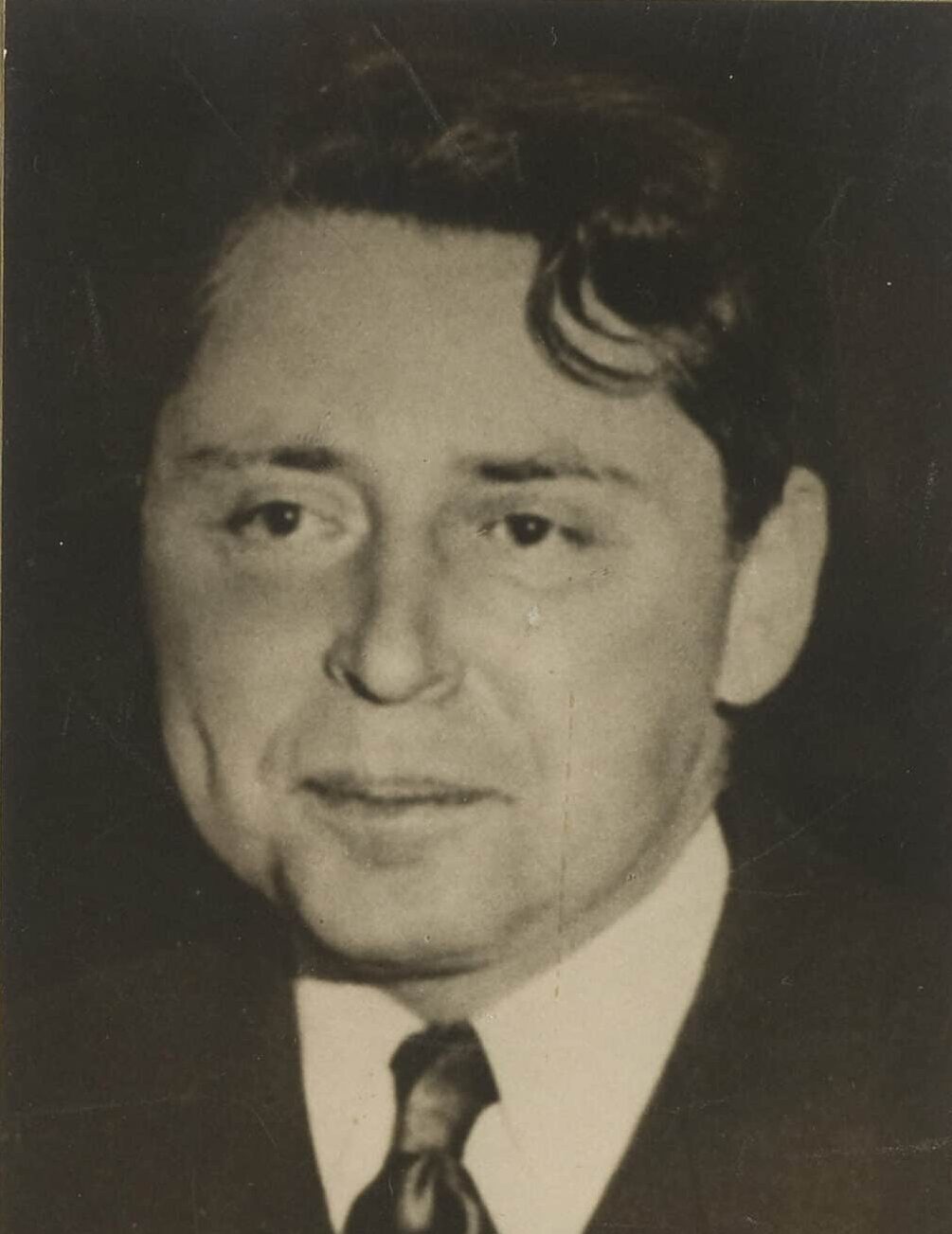
Jacques Goudstikker was a renowned Dutch art dealer. Due to his Jewish origins, he and his family were forced to flee after the German Wehrmacht occupied the Netherlands. Only 60 years after his tragic accident, which he suffered while fleeing on the crossing to Great Britain, his heirs were able to recover parts of his art collection.
A tradition of art

Amsterdam City Archives, Archives of Jacques Goudstikker and Desi Goudstikker-Halban
In 1845, brothers Jacob and Simon Goudstikker found the gallery J. Goudstikker in Amsterdam. They trade in art objects and furniture. In 1890, Jacob’s son Eduard joins the business. He expands the range to include Dutch and Flemish paintings from the 17th century. In December 1895, Eduard marries the German Emilie Eugenie Sellisberger. On August 30, 1897, their son Jacques Goudstikker is born in Venlo.

Amsterdam City Archives, Archives of Jacques Goudstikker and Desi Goudstikker-Halban
Jacques first studies at a commercial school and began working in his family's art business in 1919. At the same time, he studies art history in Utrecht and Leiden. Like his father, Jacques also changes the gallery's program. Under his influence, the catalogs are now published in French and Italian art is offered alongside Dutch painting.
New directions

Amsterdam City Archives, Archives of Jacques Goudstikker and Desi Goudstikker-Halban
In January 1924, Eduard Goudstikker passes away. From then on, his son Jacques runs the gallery alone. On September 16 of the same year, he marries Johanna Maria Catharina Bray, who was born in Suriname. 1927 Jacques Goudstikker decidse to sell the former shop at Kalvestraat 73. The J. Goudstikker gallery, named after Jacques‘ grandfather Jacob, is now located at Amsterdamer Herrengracht 458. Herrengracht is one of the main canals in Amsterdam; the gallery is therefore in the best location in the city. Here he builds up an international reputation and advises well-known collectors such as Heinrich Thyssen-Bornemisza.

Amsterdam City Archives, Archives of Jacques Goudstikker and Desi Goudstikker-Halban
In addition to the new shop, in 1930 he also purchases the castle Nijenrode in Breukelen. He uses the castle as a display space for his gallery. The salons of the house are each dedicated to a different era.
The exhibitions are open to the general public so that art lovers who cannot afford their own collection can also access art. Together with his wife, he moves into the Oostermeer mansion in Ouderkerk aan de Amstel, a few kilometers south of Amsterdam.
However, his professional success is overshadowed by a personal tragedy: On December 5, 1936, his wife Johanna dies at the age of just 51.

Amsterdam City Archives, Archives of Jacques Goudstikker and Desi Goudstikker-Halban
A Viennese ball in the Netherlands
On June 17, 1937, Jacques Goudstikker organises a charity event at his castle in Nijenrode. The theme is Viennese art; the proceeds are intended to benefit Jewish people in Germany suffering under the racist persecution in the Nazi state. In addition to the famous Concertgebouw Orchestra and the ballet ensemble of Toni Birkmeyer, he invites the Austrian soprano Dési von Halban. She had grown up in Vienna as the daughter of an opera singer and a doctor.

Amsterdam City Archives, Archives of Jacques Goudstikker and Desi Goudstikker-Halban
Dési Halban and Jacques Goudstikker fall in love. They get married already in December 1937. Their son Edouard is born in 1939.
The National Socialists in the Netherlands

Amsterdam City Archives, Archives of Jacques Goudstikker and Desi Goudstikker-Halban
Until the late 1930s, the Netherlands maintain their independence from the German Reich. Nevertheless, many Jewish citizens flee due to the political developments in the neighboring country. For this reason, Jacques and Dési Goudstikker apply for visas in 1939 to be able to enter the United States for themselves and their son.
Jacques Goudstikker has difficulty deciding to flee his homeland. In November 1939, he loads about 200 works of art from his collection onto the ship „Simon Bolivar“ to save them from the advancing war to England. On November 18, the ship runs into a German minefield off the English coast and sinks. In the sinking, 83 people die, and Goudstikker’s 200 works of art are lost.

Public domain, National Archives of the Netherlands
In May 1940, the Wehrmacht troops march into the Netherlands. They bomb Schiphol Airport, which is located only a few kilometers from the Goudstikkers’ residence in the Oostermeer house. When the Dutch government capitulates shortly thereafter, the family finally decides to flee.
In preparation for his escape, Jacques Goudstikker summoned his employees to the gallery on May 14, 1940. He appointed two employees – Jan Dik Senior and Jan Dik Junior – to take care of the art collection in his absence.
That same evening, the Goudstikker family left the Netherlands aboard the ship „Bodegraven“ to first flee to Dover in England.
A tragic accident

Amsterdam City Archives, Archives of Jacques Goudstikker and Desi Goudstikker-Halban
The „Bodegraven“ cannot dock in Dover – the British suspect that German spies may be on board. South America is set as the new target. Still housed in a cramped cabin below deck, Jacques Goudstikker goes on deck at night to smoke a cigarette. To protect himself from attacks, the ship is darkened. Therefore, Goudstikker overlooks an open deck hatch and falls in; the accident is fatal.
The ship docks in Falmouth on the south coast of England to facilitate a burial in the sea for Goudstikker. His widow had previously refused a burial at sea. His family is not allowed to attend the burial. Desi and Eduard Goudstikker continue their journey across Canada to the USA.

Public domain, via Wikimedia Commons
Shortly after the Goudstikkers fled from the Netherlands, Alois Miedl, on behalf of Hermann Göring, took control of the gallery business. To this end, Miedl, an NS-aligned banker from Munich, contacted Goudstikkers„ former employee Jan Dik Senior, who remained active in the art dealership after the NS takeover. Acting on behalf of Göring, Miedl “bought” the business, all the real estate, and the entire remaining art collection of Goudstikkers for 2.5 million guilders, bypassing the rightful heir, Desi Goudstikker.

Public domain, via Wikimedia Commons.
Hermann Göring takes over important works of art, Miedl the real estate and the gallery, including its good reputation. Göring has 780 works brought to Germany; the best of them end up in his country estate Carinhall. Göring sells the less important works with great profit to German museums and art dealers. Another hundreds remain in the Netherlands, where Miedl trades with them through the Goudstikker gallery, whose name he retains.
Long road to inheritance

Amsterdam City Archives, Archives of Jacques Goudstikker and Desi Goudstikker-Halban
After the war ends, the art dealership J. Goudstikker is taken over by the Dutch state. To recover its property, Dési Goudstikker, who remarried in 1950 and is now known as Saher, files a lawsuit against the Dutch state. Upon his death, Jacques Goudstikker carried a small black notebook – the so-called „Blackbook“ – with him in which he had recorded over 1200 works in his possession. His widow can rely on this when claiming her share of the proceeds. In 1952, however, the widow had to withdraw her lawsuit due to lack of financial means. She did not receive back the works of art, but only a portion of the sum for which the gallery was forcibly sold in 1940.

Amsterdam City Archives, Archives of Jacques Goudstikker and Desi Goudstikker-Halban
For decades, the Netherlands has not been committed to returning the works of the J. Goudstikker collection that are being returned from Germany. The family does not receive them; instead, they are distributed to various museums in the country. In 1996, Dési and Edouard Goudstikker, who were the rightful heirs of the collection of Jacques Goudstikker, died without ever being able to reclaim it. Eduards wife Marei, Dési’s and Jacques Goudstikkers’s mother-in-law, took up the fight for the family inheritance. It was not until 2006 that she received about 200 works from the Goudstikker collection.

Painting Gallery of Old Masters, State Art Collections of Dresden
In 1953, the State Art Collections of Dresden acquired the work „Blumenstillleben“ by Rachel Ruysch from a Dresden art dealer for the Alte Meister painting gallery. The dealer presented a touching story in which the Nazi crimes in the Netherlands and the Amsterdam art dealership Goudstikker do not appear. However, on the back of the painting there is a sticker with the inscription „Collectie Goudstikker, Kalvestraat 73, Amsterdam, No. 686“. In Jacques Goudstikker’s „Blackbook“, under number 686, the title and the description of the Dresden painting acquired in 1953 are found. In 1953, the existence of the „Blackbook“ and the significance of the numbers as a watershed for a Nazi-persecution-related confiscation were not yet known. All works still handwritten by Jacques Goudstikker in the „Blackbook“ are today considered confiscated due to Nazi persecution and must be returned if they appear in the trade, in museums, or with collectors. Rachel Ruysch’s „Still Life with Flowers“ can undoubtedly be attributed to the forfeited stock of the Amsterdam art dealer via the low Goudstikker number 686, and can be restituted to the heirs of Jaques Goudstikker in 2006 following proactive action by the SKD.

Painting Gallery of Old Masters, State Art Collections of Dresden
Today, ten works of art are still in the collection of the Alte Meister Painting Gallery; stickers and labels on the back of these works refer to the J. Goudstikker Gallery. However, these paintings, as well as a drawing in the copperplate cabinet, were only brought into the collection and traded after the expropriation and takeover of the art dealership. Accordingly, they are not listed in Jacques Goudstikker’s „Blackbook“. A Nazi-persecution-related withdrawal is nevertheless not to be ruled out, because Miedl also sold a significant amount of NS looted art in the Goudstikker art dealership. Therefore, the SKD’s Provenance Research team is continuing to investigate the provenance of these works and is trying to determine who owned them before they were brought into the ‚arrived at” Goudstikker art dealership. The works are listed as finds in the publicly accessible Lost Art database of the German Center for Cultural Property Losses, in the hope of receiving any clues that may help clarify their origin.





